
The Queen Will Lead
Leadership Falls to the One Who Has Lived the Board

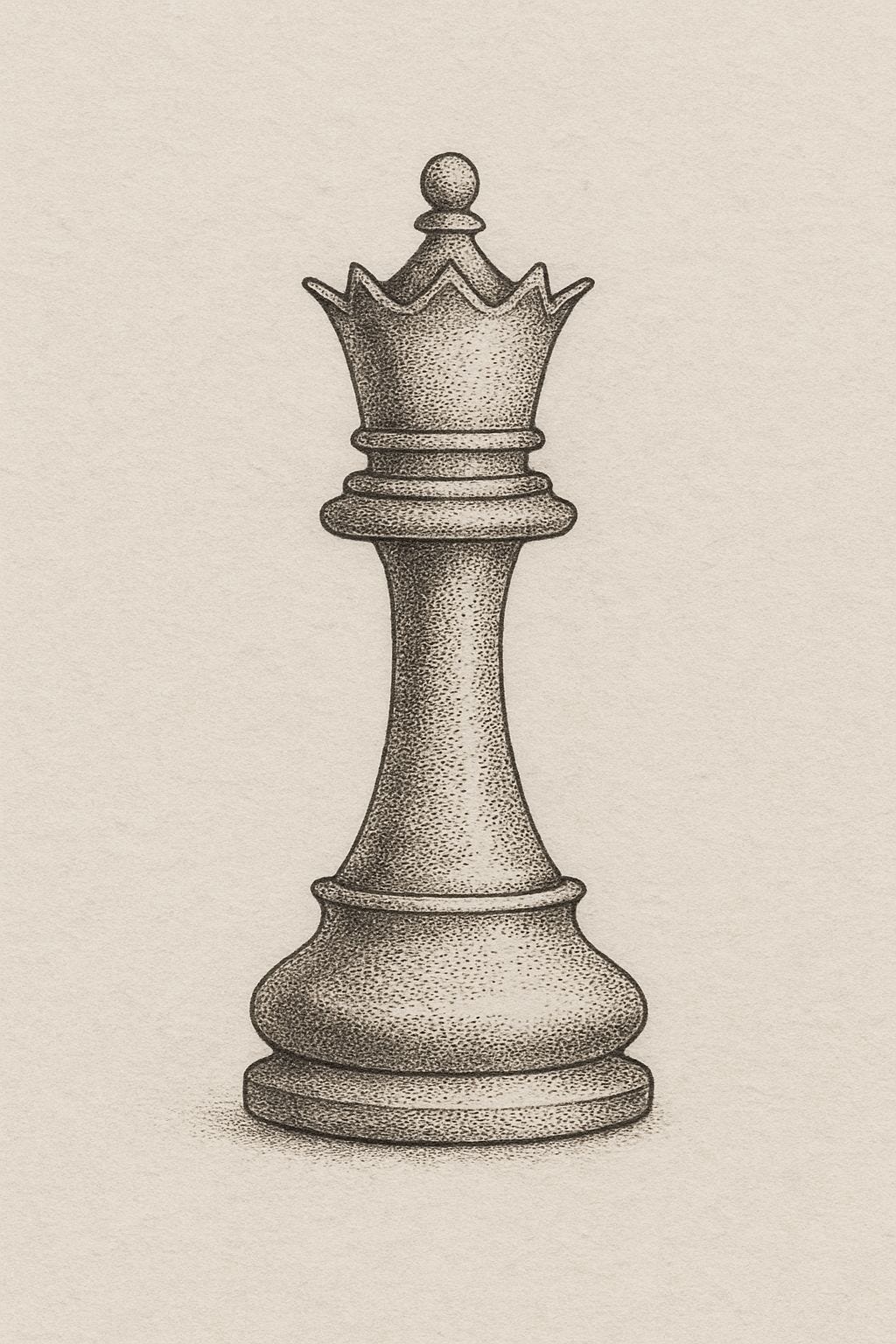
That is not a sentimental detail. It is not decorative. It is structural. The queen has range. She can move across the whole field. She can defend, intervene, advance, recover, and alter the shape of the game in a way no other piece can.
And yet the king sits at the centre.
That arrangement is worth examining.
The king is central, but his centrality is not the same thing as capacity. He is important because the whole structure has been organized around his preservation. His movement is narrow. His exposure is dangerous. His survival depends, in no small part, on the far greater range of the queen.
That is a revealing pattern.
The most capable figure is not the one enthroned at the centre, but the one tasked with preserving it.
For a very long time, societies have worked in much the same way. Male authority has been staged, protected, formalized, and treated as though it were naturally fitted to rule. But beneath that staging has been another reality: a quiet dependence on the capability of women. Not only their labour, but their judgment. Not only their effort, but their range. Their ability to carry complexity, to hold families together, to read people, to anticipate danger, to absorb consequence, to act across multiple fronts at once.
Civilization has long survived on female competence while continuing to flatter male authority.
That is why the queen matters. She is not simply a woman placed on the board. She is a recognition of range. She represents the figure who can move in more than one direction, who can see more than one problem at once, and who can alter the conditions of survival for everyone else.
But even the queen has historically been given a task. Her power has often been permitted on the condition that it serve the king. She may move widely, provided that her movement ultimately protects the centre already chosen for her. Her range is acknowledged, but its purpose is constrained.
The same has been true of women.
She embodies a familiar arrangement: all responsibility, without the power the position requires
Again and again, women have been permitted intelligence, endurance, competence, even extraordinary power, so long as these were spent in support of structures built around male continuity. They could build, carry, mend, regulate, anticipate, soothe, manage, protect, and rescue. They could hold the field together. But they were not always permitted authorship. They were not always granted the seat that matched the scale of their contribution.
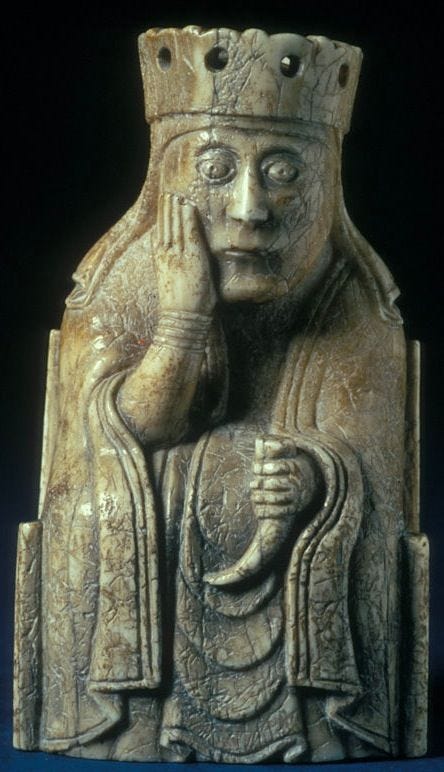
This becomes even sharper in the figure of the crone.
The modern world has made that word sound unpleasant on purpose. It has been made to suggest irrelevance, decline, bitterness, or the loss of value. But the crone is none of those things. She is not a failed maiden. She is not a woman who has lost her use. She is the woman in whom capacity has consolidated.
She has done the building, carried the weight, raised the children, worked, endured, and lived long enough to learn the board.
She has seen motives. She has watched patterns repeat. She has learned who moves honestly and who does not. She has understood the difference between appearance and structure, between performance and consequence, between centrality and competence. She has spent enough of herself in protection to know when protection is necessary and when it becomes self-erasure.
When she has done the building, carried the weight, raised the children, worked, endured, and learned the board, she is not waiting to be chosen. She is ready to take her seat.
That is the crone.
Not an object of pity. Not a cultural leftover. Not an embarrassment to youth. But the mature form of female range: less ornamental, less easily flattered, less available for manipulation, more difficult to override. She does not need to be imagined into authority. She has already earned it. The real question is whether society is capable of recognizing what it has long relied upon.
Even older than the chessboard, there are traces of this recognition. The enthroned feminine appears far back in human memory, not as decoration, but as an ordering presence. The woman seated in authority is not a modern fantasy. She belongs to a much older civilizational layer. The queen on the chessboard may be only the later, formalized memory of a deeper truth: that female power was always larger than the subordinate roles later assigned to it.
Perhaps that is why the figure still carries force.
The queen is not merely powerful. She is the one with range. And range matters now more than ever. We are living through a time in which symbolic leadership is failing everywhere. We are surrounded by brittle authority, theatrical command, protected incompetence, and institutions still too ready to mistake male occupancy of power for fitness to wield it. The old arrangement is visibly exhausted.
More than ever, leadership falls to the one who has lived the board.
Not the one most protected by the structure, but the one who understands it. Not the one enthroned by convention, but the one who can actually move. Not the one around whom everything has been arranged, but the one who has spent a lifetime arranging, carrying, repairing, and surviving.
The queen has long been asked to protect the centre.
Perhaps the time has come for her not merely to defend the structure, but to determine it.
Perhaps the time has come for her to emerge from custodianship into authorship.
The queen will lead.