

Mary and Durga
Two Mother Archetypes: One Kept Her Claws. One Did Not.

Across cultures, central female figures recur with striking consistency. They stand upright, composed, often positioned over a threat — not as victims, but as authorities at the boundary between life and violation. When placed side by side, Durga and Mary appear to occupy the same symbolic space: mother, moral centre, guardian of life.
Yet what each figure is permitted to do could not be more different.
One remains whole.
The other is carefully constrained.
This difference is not decorative. It is structural.
Durga: protection without apology
Durga’s myth could be misread as simple violence. It is not.
In the Durga–Mahishasura story, the demon Mahishasura does not merely appear as a buffalo — he inhabits a buffalo body. This detail matters. The buffalo is cattle, and cattle across agrarian cultures are not symbols of evil or chaos. They are symbols of fertility, nourishment, continuity, and generative wealth. They are life-support systems, particularly associated with the female generative principle.
Durga does not kill the buffalo.
She forces the male demon out and kills him at the moment of emergence.
This distinction is frequently overlooked, yet it is the core of the myth. The target is not generative life. The target is parasitic occupation of a generative system.
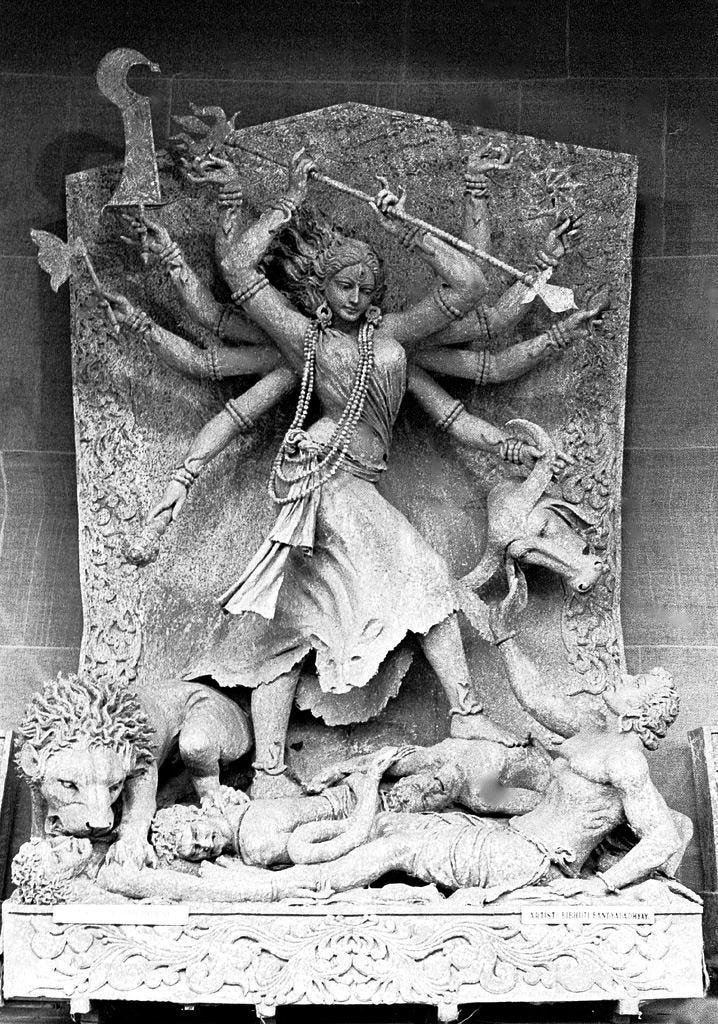
This distinction feels uncomfortably current.
Durga’s ferocity is not indiscriminate. It is precise, discriminating, and timed. She destroys the force that exploits life from within while preserving the generative vessel itself. Her authority lies in knowing the difference.
Durga shows us what intact generative guardianship looks like.
Generation requires protection
This is not metaphor. It is biology.
Creation without protection is not virtue; it is vulnerability. Any system that generates life must also be capable of defending it when violated. This is obvious across species, ecosystems, and human societies.
Protective force is not cruelty.
It is boundary enforcement.
Durga embodies this rule without confusion or apology. Her capacity to act is integral to her role as mother and guardian. Ferocity appears only when life is threatened — and disappears when it is not.
The Seven Sisters: a universal custodial logic
Durga does not stand alone. She belongs to a far older and widely distributed lineage of female custodianship, encoded across cultures in the Seven Sisters, or Pleiades, traditions.
These stories appear independently across South Asia, the Mediterranean, Indigenous Australia, the Americas, and beyond. Their universality matters. When a narrative pattern emerges across unrelated cultures, continents, and ecologies, it is not ideology — it is infrastructure.
In the Seven Sisters traditions, a male pursuer repeatedly attempts to capture, enter, or appropriate female generative power. In many Aboriginal Australian versions, he takes the form of a carpet snake entering a waterhole — the fixed source of life, fertility, and continuity in arid landscapes.
The structure is identical to the Durga myth:
A male figure does not create the generative source.
He enters it.
He attempts to appropriate its power.
Female authority responds by removing him.
Buffalo body or waterhole.
Mobile vessel or fixed source.
Different ecologies. Same rule.
The crime is entry, not existence.
The threat is parasitic occupation, not sexuality.
The response is removal, not moral condemnation.
This distinction is never confused in these systems.
Christianity as aberration
The near-universal presence of Seven Sisters myths suggests that the protection of female generative power was once common human knowledge. Christianity stands apart not because it failed to inherit this understanding, but because it deliberately reconfigured it.
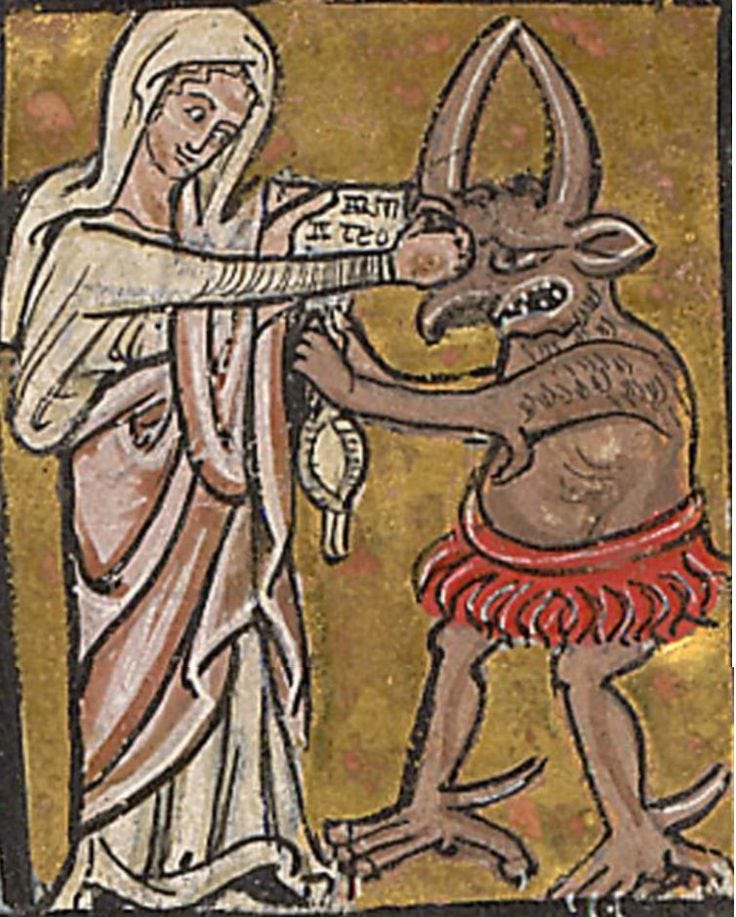
Where earlier systems maintained a clear distinction between generative life and parasitic occupation, Christianity collapsed the distinction. Fertility itself became suspect. Animal vitality became “beastly.” Female authority over protection became dangerous.
This was not accidental. It served hierarchy.
Mary: the appropriated, curated, fragmented remnant
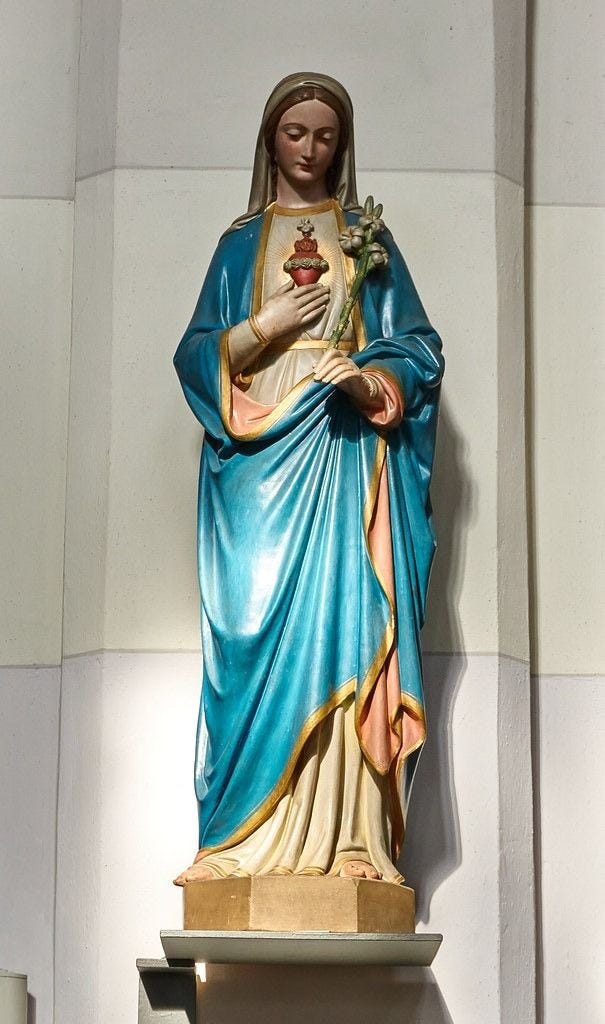
Mary is not weak. She is edited.
Christianity inherited an ancient maternal lineage — one in which generative power included the right to judge, to act, and to protect life. But Mary was curated to fit a system invested in obedience, hierarchy, and male monopolies of authority.
What remained was reverence without authority.
Maternity without ferocity.
Creation without defence.
Mary may stand.
She may endure.
She must not strike.
Her stillness is sanctified. Her obedience becomes virtue. Ferocity — the necessary companion of creation — is forbidden.
Mary is best understood not as Durga’s opposite, but as the appropriated, curated, fragmented remnant of the same maternal logic, stripped of its claws.
The cost: confusion, not passivity
Women were never passive in practice. They birthed, fed, protected, negotiated, and survived. But they were taught to misname their own force.
Protection became guilt.
Anger became sin.
Boundary-setting became moral failure.
The damage was not submission.
It was confusion.
Generations of women internalised a symbolic model that contradicted their biology, their social role, and their lived reality. They were asked to generate life while being denied the authority to defend it.
That contradiction leaves scars.
Indigenous clarity
In cultures not reorganised around Christian hierarchy — including many Indigenous societies — women were never expected to be passive. They were expected to be decisive, directive, and authoritative where life was concerned.
Authority flowed toward those who generated and sustained life.
These cultures were not idealised utopias, but they were not symbolically confused about women’s role in protection. Female ferocity was neither demonised nor sentimentalised. It was understood.
Where colonisation succeeded, female authority was among the first casualties — materially and symbolically. Where colonisation failed to overwrite myth entirely, that authority endured.
This was not incidental.
It was cultural refusal.
What Durga still shows us
Durga is not an alternative to Mary.
She is a reminder of what was removed.
She shows that generative power, when intact, knows exactly when and how to act. She reminds us that creators are not meant to be de-nailed — stripped of claws, teeth, and talons — and then asked to safeguard life anyway.
Creation demands protection.
Protection demands authority.
Any system that venerates creation while forbidding its defence is fundamentally hostile to life, no matter how gentle its imagery.
Fucking brilliant. Thank you. This is the first article I've read of yours, I'm looking forward to exploring the archive!
https://preventivehealth.substack.com/p/the-indus-valley-seal-is-proof-that?utm_source=share&utm_medium=android&r=5v5e3s