

How Writing Allowed Knowledge to Be Claimed, Extracted, and Monetized
The Appearance of Knowledge Has Replaced the Real Thing

Through the written word, the claim to knowledge became authority — and authority, in time, became currency.
For most of human history, knowledge moved through living conversation. A person spoke, another listened. Questions were asked. Confusion appeared on a face, and the explanation changed. Meaning was negotiated in real time until both people understood the same thing.
In oral traditions the responsibility for understanding was shared. The speaker adjusted to the listener, sensing when something had landed and when it had not. If the idea was new or difficult, examples could be added, stories told, demonstrations given.
Meaning was alive.
Writing changed this dynamic profoundly. Once ideas could be written down, they could travel far beyond the people who originally understood them. Words began to circulate without the speaker who could clarify them. The feedback loop disappeared.
The reader was left alone with the text.
If the reader misunderstood, the author was not there to correct it. If the reader lacked the experience required to interpret the idea properly, the meaning could drift. Over time, interpretation began to take the place of understanding.
This is where a new phenomenon emerged.
Through the written word, claiming knowledge became possible without demonstrating it. A person could write about a body they had never observed in practice, about a culture they had never lived within, or about ancient symbols whose original context had long disappeared.
Once written, those interpretations could circulate. If repeated often enough, they could acquire the appearance of authority.
Authority, once established, became currency.
We see this process clearly in the interpretation of historical artifacts. When nineteenth-century British archaeologists encountered the famous Pashupati Seal, they interpreted the seated figure as a male deity and connected it with the Hindu god Shiva. But this interpretation reflected the conceptual framework of Victorian scholars more than the worldview of the civilisation that produced the image.
Those archaeologists came from a culture accustomed to hierarchical pantheons dominated by male gods. When they encountered a mysterious ancient figure, they interpreted it through that lens. Yet the original meaning may have been entirely different. It may have represented protection of mothers, the guardianship of life, or a symbolic acknowledgment of forces that sustain human existence.
Once the interpretation entered written scholarship, however, it began to circulate as established knowledge.
A similar pattern appears in the Gundestrup Cauldron. One panel shows a horned figure seated among wild animals, holding a serpent and a torc. Modern scholars often describe this figure as the Celtic deity Cernunnos.
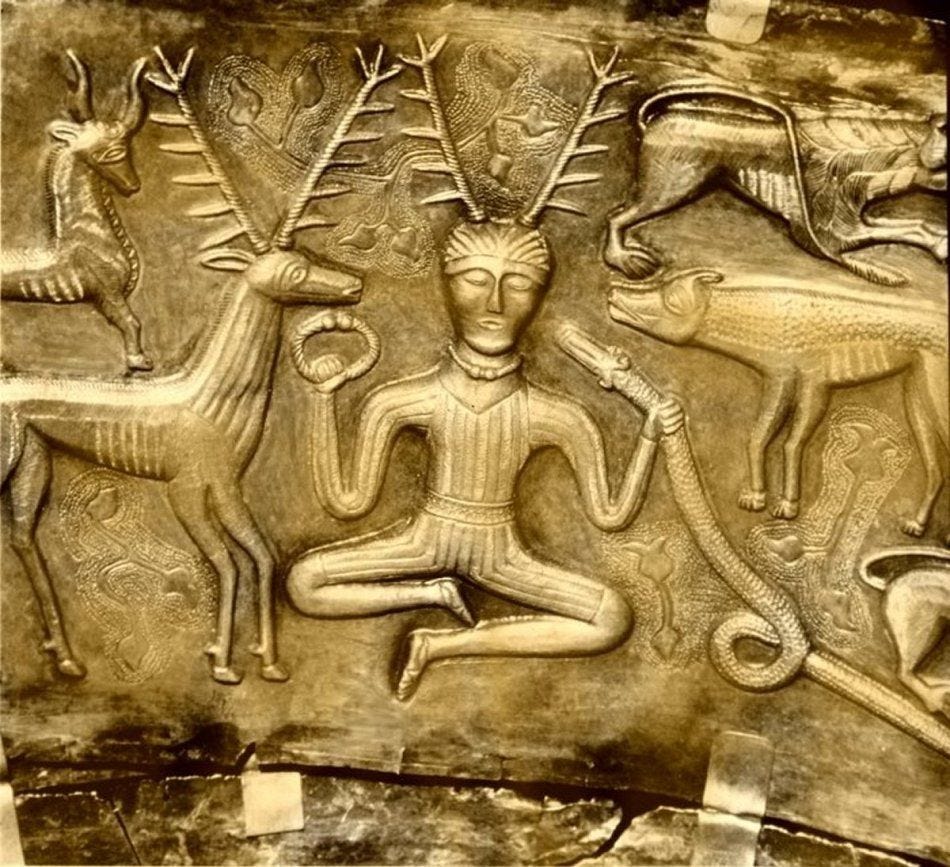
Yet across many cultures there are stories of individuals capable of sitting calmly among animals, their physiological stillness allowing the creatures around them to remain at ease. Without the living traditions that once explained such images, modern interpreters project familiar categories onto them. What may once have represented a human relationship with the natural world becomes recast as a mythological god.
We are not always reading the past.
Sometimes we are reading our own assumptions back into it.
This phenomenon extends far beyond archaeology. In modern health writing, ideas about the body are often repeated by people who have never observed those processes unfold in practice. Readers, lacking the physiological grounding to evaluate those claims, must rely on the apparent authority of the writer.
This difference between lived observation and written authority is familiar within Western medicine. Charted vital signs are prioritised over bed-side observation. Trials and studies focus on a singular parameter not up-stream causes. Authority flows to those with longer academic training, even though most real learning happens on the job.
What circulates begins to resemble knowledge, but it is often interpretation layered upon interpretation.
During the COVID restrictions, many people experienced a small glimpse of how fragile understanding can be when human communication is reduced. With faces covered, distance enforced, and much interaction pushed into written or digital forms, subtle cues of comprehension and confusion disappeared. The small adjustments that normally occur in conversation became harder to make.
It was a reminder of something older.
Meaning depends on relationship.
Oral traditions preserved that relationship. Knowledge remained tied to experience, responsibility, and the ability to correct misunderstanding in real time.
Writing made knowledge portable. But it also detached knowledge from the conditions that gave it meaning.
Once detached, knowledge could be claimed, extracted, and monetized.
And over time, the appearance of knowledge began to replace the real thing.