

Āsana आसन
Training and Preparing Your Terrain


Āsana isn’t gymnastics. It isn’t calisthenics. It’s a much more sophisticated practice — layered with intelligence and depth.
Off the mat, it’s preparation for life.
On the mat, it’s preparation for Śavāsana, Prāṇāyāma, and Dhyāna — for the steadiness required to rest, to breathe, and to meditate.
Each posture is a rehearsal for steadiness — a form of stress-tolerance training, not in the metaphorical sense but in the physiological one. You learn to remain composed under load, to stay steady when the instinct is to escape.
You meet the unfamiliar and learn not to flinch. You meet the uncomfortable and learn not to panic. You meet boredom, strain, imbalance, or intimidation — and learn to stay.
This is how yoga changes you.
Each practice session quietly rewires the nervous system that has been shaped by years of conditioning — family, culture, workplace, environment. You stop reacting according to other people’s patterns. You become the steady one: reliable, grounded, able to be trusted even when the world around you is losing balance.
And when you remain steady under threat, you calm the field. Your regulated energy becomes the reference point for others. The steadiness you cultivate doesn’t stop at your skin — it ripples outward, restoring coherence in families, workplaces, and communities. This is the invisible social medicine of yoga: one nervous system teaching others how to settle.
In Patañjali’s Yoga Sūtra 2.46 — sthira-sukham āsanam — āsana is described as a state that is steady and comfortable.
As the breath steadies, chemistry steadies; from that, comfort arises.
The Physiology Beneath the Practice
What appears to be stillness from the outside is a living conversation within. Every āsana reorganises pressure, chemistry, and signal flow through the body’s internal terrain.

The Two Components of Āsana
Āsana increases local metabolism, mildly raising local acidity. The longer a posture is held, the more the working tissues produce CO₂, which dissolves into carbonic acid and lowers local pH. Combined with conscious breathing, this inhibits unconscious over-breathing.
It might seem paradoxical, but tissue oxygenation needs a little acidity. Slowing the breath while maintaining muscular work increases acidity — a necessary signal for oxygen release from haemoglobin, known as the Bohr effect.
That same mild acidity relaxes the smooth-muscle walls of arterioles, restoring blood flow to the organs and the brain while improving warmth and oxygen delivery to the extremities: the hands, the feet and the skin. The “heat,” “alignment,” or “opening” people describe are not metaphors: they’re signs of restored ionic balance and circulation.
When the chemistry changes, the nervous system follows. Acid-based muscle relaxation interrupts the small spinal reflex arcs that hold the body in defensive tension. That is why sustained postures leave you calm rather than fatigued — they re-educate your reflexes through chemistry.
Structure, Balance, and Sensory Intelligence
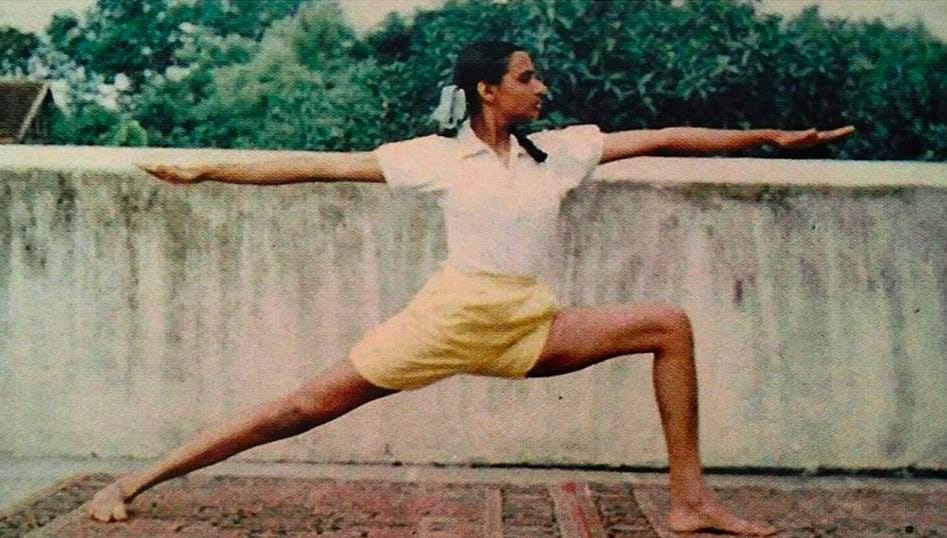
Every āsana builds proprioception — the body’s sense of itself in space. It strengthens the small stabilising muscles that keep you upright and aligned, stretches fascia, and teaches the body to distribute load evenly.
When you breathe slowly inside a demanding pose, you teach your body that difficulty does not equal danger. The breath becomes a metronome of safety. Over time, this forms new body memory: to meet challenge without panic, to maintain equilibrium under strain. That is genuine stress-tolerance training.
Alignment and the Longevity of Joints
Alignment isn’t cosmetic; it’s preventive medicine. Uneven muscle tone pulls joints off-axis, creating micro-shear forces — the quiet beginnings of arthritis or tendon wear. Conscious āsana lengthens these distortions and redistributes load through the skeleton. Stretching becomes mechanical hygiene, not ornament. Balanced joints invite circulation, release fascia, and ease inflammation.
Releasing the Body’s Wiring and Plumbing
As muscles and fascia lengthen, the nerves, lymph vessels, and blood vessels threaded through them regain space. In habitual posture these channels coil and compress, slowing signals and flow. Sustained āsana decompresses them, restoring a direct current of communication — neural, vascular, and energetic.
Each posture becomes an act of decompression, freeing the body’s wiring and plumbing so the inner currents can move without resistance. You don’t have to practice daily, but regular release keeps the body’s infrastructure clear.
Preparing the Ground for Śavāsana and Prāṇāyāma
All of this prepares the terrain for the subtler practices that follow. When tissues are metabolically alive, joints aligned, and internal channels open, the body can rest into Śavāsana without resistance and breathe through Prāṇāyāma without strain.
Āsana creates the chemistry and space in which stillness and breath can truly work — the groundwork for meditation, for steadiness, and for the calm that spreads through the field around you.

One of Richard Freeman’s long ago quotes that has always stuck with me, ´yoga ruins you for this world’ once you are open to what it teaches, there’s no going back.
Hi Catherine, I want to thank you for this and all your posts. I so look forward to reading everything you write. You’re the best writer about yoga I’ve come across, as compelling as Dona Holleman but with added expertise in the physiology and biology. With deep gratitude from California! - Joanna